Week 8 - Nanotechnology + Art
One big discovery was the buckyball, or Buckminsterfullerene, found in 1985. This is a molecule made of 60 carbon atoms shaped like a soccer ball. It led to the creation of carbon nanotubes, which are super strong and very light. The STM, invented in 1981, lets scientists see and move single atoms. These inventions changed how we can work with materials at the smallest scale.

(Buckyball (C60) Model)
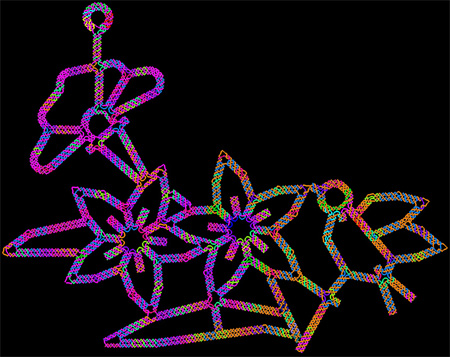
Paul Rothemund’s TED talk showed how nature already uses nanotechnology. Scientists can fold DNA into different shapes, like origami, to make tiny machines or deliver medicine exactly where it’s needed. This is called “bottom-up” building, starting with the smallest pieces and letting them assemble themselves.
Ray Kurzweil talked about a future called the “singularity,” where artificial intelligence and nanotechnology come together to change everything. He thinks that if we learn to program life at the molecular level, we could make huge advances in intelligence and health.
What amazed me most is how nanotechnology is turning science fiction into real science. We can now see and move atoms, make new materials, and even design tiny machines using DNA. The lectures and talks made me realize that nanotechnology is not just a new tool but a whole new way of understanding and building the world around us.

“Nanotechnology: Jim Gimzewski (UCLA)” YouTube, uploaded by UCLA, 13 Jan. 2011, www.youtube.com/watch?v=q7jM6-iqzzE.
“Nanotechnology: Jim Gimzewski (UCLA) - Breakthroughs” YouTube, uploaded by UCLA, 13 Jan. 2011, www.youtube.com/watch?v=HEp6t0v-v9c.
“Nanotechnology: Jim Gimzewski (UCLA) - Applications” YouTube, uploaded by UCLA, 13 Jan. 2011, www.youtube.com/watch?v=X0HCNiU_108.
“Nanotechnology: Jim Gimzewski (UCLA) - Nature’s Nanotechnology” YouTube, uploaded by UCLA, 13 Jan. 2011, www.youtube.com/watch?v=yHCuZetAIhk.
“Nanotechnology: Jim Gimzewski (UCLA) - Buckyballs and Nanotubes” YouTube, uploaded by UCLA, 13 Jan. 2011, www.youtube.com/watch?v=4OWc8nmHJmY. Accessed 23 May 2025.
“Nanotechnology: Jim Gimzewski (UCLA) - Scanning Tunneling Microscope” YouTube, uploaded by UCLA, 13 Jan. 2011, www.youtube.com/watch?v=oKlViSKkPd0.
Rothemund, Paul. “DNA Folding, in Detail.” TED, Feb. 2008, www.ted.com/talks/paul_rothemund_dna_folding_in_detail?language=en.
Kurzweil, Ray. “A University for the Coming Singularity.” TED, Feb. 2009, www.ted.com/talks/ray_kurzweil_a_university_for_the_coming_singularity?language=en.


Comments
Post a Comment